HIPAA Compliance That Produces Evidence, Not Just Checklists
Track every Business Associate Agreement. Automate breach notification workflows. Generate documentation that satisfies OCR auditors, not just your internal checklist.
What regulated organizations face today
Healthcare organizations manage dozens to hundreds of vendor relationships involving protected health information. Most track BAAs in spreadsheets, filing cabinets, or scattered SharePoint folders. When OCR comes knocking, assembling evidence takes weeks. Breach notification timelines get missed because nobody owns the workflow. Risk assessments are snapshots that go stale the day they're completed.
The real cost is not the fine. It's the operational chaos between audits. Staff hours burned chasing attestations. Vendors operating without current BAAs. Security incidents without documented response procedures. Every gap is potential liability that compounds until someone asks for proof.
HIPAA enforcement at a glance
60 days
HITECH breach notification deadline to individuals
100%
Of vendors handling PHI require an executed BAA
How AlignSure solves it
BAA Lifecycle Management
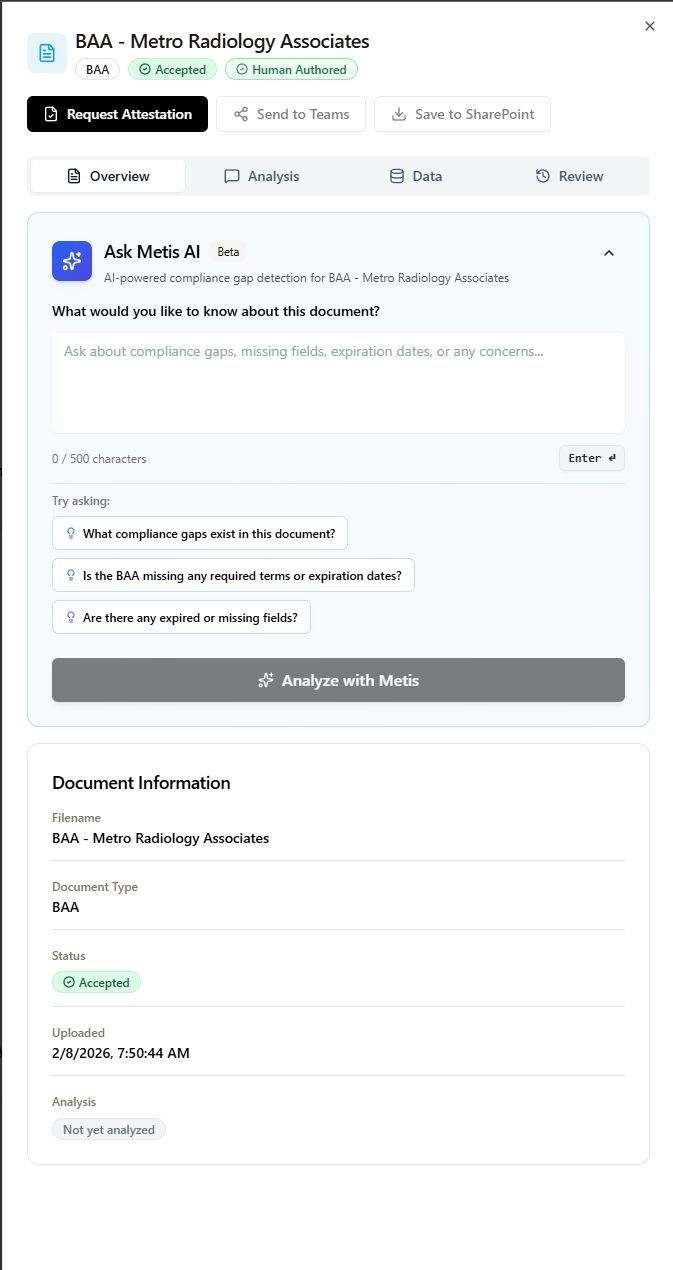
Track every Business Associate Agreement from execution through renewal and termination. Automated expiration alerts. Version history with signer attestation. Complete audit trail of every BAA interaction.
Breach Notification Workflows
Structured incident response workflows aligned to HITECH breach notification timelines. Identity-bound documentation of every step. Automated escalation when deadlines approach. Evidence packages ready for HHS reporting.
Risk Assessment Documentation
Continuous risk assessment evidence collection, not annual snapshots. Map controls to HIPAA Security Rule requirements. Document safeguards with automated evidence from your Microsoft 365 environment.
Vendor Compliance Tracking
Monitor Business Associate compliance status across your entire vendor network. Track attestations, security questionnaire responses, and compliance certifications. Flag vendors with expired or missing documentation.
Key platform capabilities
What your auditor, underwriter, or regulator receives
- Complete BAA inventory with execution dates, signers, and renewal status
- Breach notification timeline documentation with identity-bound actions
- Risk assessment reports mapped to HIPAA Security Rule requirements
- Vendor compliance attestation records
- Access control documentation with Microsoft Entra ID integration
Regulatory frameworks addressed
Frequently asked questions
What is a Business Associate Agreement (BAA)?
What are the penalties for HIPAA non-compliance?
When is breach notification required under HITECH?
What does the HIPAA Security Rule require?
How often should HIPAA risk assessments be performed?
Operational HIPAA Management, Not Just Technical Controls
Many compliance platforms approach HIPAA as an IT security checklist: vulnerability scans, access logs, encryption verification. Those controls matter, but they cover only the Security Rule. Healthcare organizations also need to manage Privacy Rule obligations: BAA lifecycles across dozens of vendors, breach notification workflows with HITECH 60-day timelines, workforce training documentation, and minimum necessary access enforcement. AlignSure manages the full operational scope of HIPAA: Privacy Rule, Security Rule, and HITECH Act, with identity-bound evidence that connects compliance activity to your existing Microsoft 365 environment. The result is documentation that satisfies OCR auditors, not just your IT security team.
Related Solutions & Resources
Business Associate Agreement
Review AlignSure's BAA framework and request execution for your organization.
Workers' Comp & FROI
HIPAA intersects workers' comp when injury treatment involves PHI. Track both in one system.
AlignSure for Healthcare
See how healthcare organizations use AlignSure for HIPAA compliance and beyond.
Security Posture
Encryption, tenant isolation, Entra ID authentication, and incident response.
Ready to see it?
Request a demo configured for your organization's specific compliance requirements.