Workers' Compensation Evidence That Moves Your Experience Mod
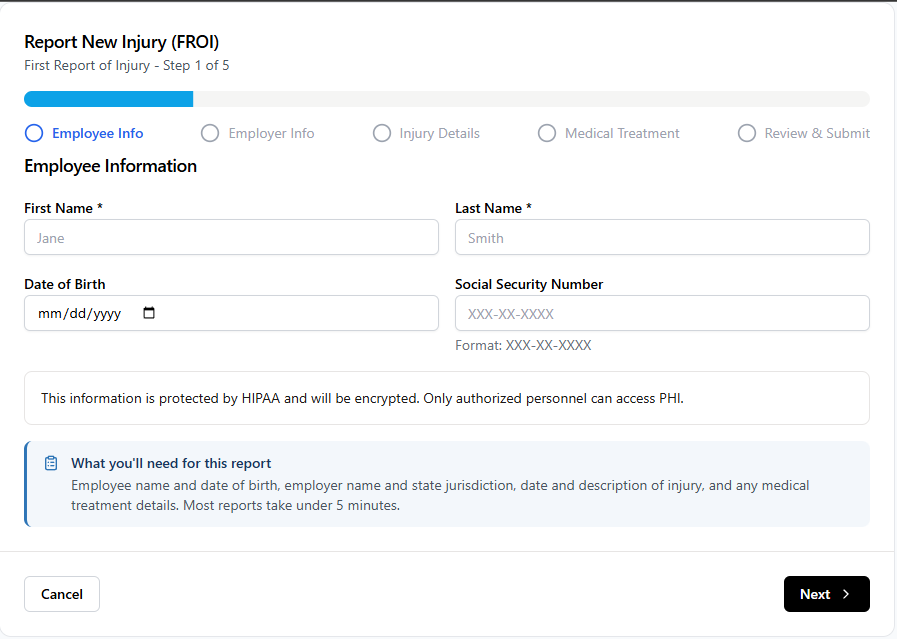
Document every First Report of Injury (FROI). Track claims from incident through resolution. Produce underwriting stewardship reports that demonstrate measurable risk reduction.
What regulated organizations face today
Workers' compensation is where compliance meets real money. Every unreported injury, every late FROI filing, every undocumented modified duty assignment costs your organization: in claims costs, in Experience Mod penalties, and in underwriter confidence. Most organizations track injuries in disconnected systems: HR has one spreadsheet, safety has another, the broker gets a summary email, and the TPA works from their own portal.
The result is a loss ratio nobody can explain, an Experience Mod that drifts upward, and stewardship meetings where the broker shows charts but cannot show evidence of systematic risk reduction. When underwriters ask "What are you doing to reduce losses?", the answer should not require a week of data gathering.
The cost of getting it wrong
$42,000
Average cost per lost-time workers' comp claim
3-5 years
Duration claims affect your Experience Mod
72 hours
Typical state FROI filing deadline
20-40%
Premium impact range from Experience Mod variance
Sources: National Council on Compensation Insurance (NCCI); Bureau of Labor Statistics
How AlignSure solves it
FROI Documentation & Filing
Structured First Report of Injury workflows that capture every required field, route to appropriate reviewers, and produce state-compliant documentation. Identity-bound submissions ensure accountability.
Claims Resolution Tracking
Track every claim from initial report through closure. Monitor treatment timelines, return-to-work milestones, and reserve development. Flag claims that exceed duration benchmarks.
Experience Mod Analysis
Connect injury data to financial impact. Model Experience Mod projections based on current claims. Identify which claims drive the most rating impact and where intervention reduces costs.
Underwriting Stewardship Reporting
Generate evidence packages for broker stewardship meetings and underwriter reviews. Demonstrate systematic safety programs, claims management processes, and measurable risk reduction, with data, not anecdotes.
Key platform capabilities
What your auditor, underwriter, or regulator receives
- State-compliant FROI documentation packages
- Claims inventory with status, reserves, duration, and resolution
- Experience Mod projection reports with claims-level detail
- Loss ratio trend analysis by location and occupation
- Stewardship meeting evidence packages (safety programs, claims management, return-to-work outcomes)
- BLS/OSHA benchmark comparisons for injury rates and days away
Regulatory frameworks addressed
Frequently asked questions
What is a First Report of Injury (FROI)?
How does the Experience Modification Rate (EMR) work?
What are typical FROI filing deadlines by state?
How do workers' comp claims affect insurance premiums?
What is modified duty in workers' compensation?
Related Solutions
Return-to-Work Planning
Coordinate recovery plans and transitional duty after a workers' comp claim.
ADA Job Validation
Essential duties documentation that supports both ADA compliance and workers' comp claims.
HIPAA & BAA Compliance
When injury treatment involves PHI, HIPAA obligations apply alongside workers' comp.
Ready to see it?
Request a demo configured for your organization's specific compliance requirements.